
What I wish I knew before starting my business (7 lessons from my mistakes😊)
If you are new to the online coaching business and digital product business world, I am sharing the little mistakes I have made since starting the business in 2020 so you can learn from them!
In this episode, I'll share 7 things I wish I knew before launching my digital product business - you know, the real mistakes, regrets, and lessons I have discovered.
If you are a coach, creator or someone in the digital product business, I hope this episode will help you start or run the business on the right foot, save money and avoid the mistakes I made :)
In this episode, you'll find out…
Whether I would recommend WordPress or Squarespace for your business website (I think the answer is obvious for more seasoned biz owners ;) )
My $200 rule when it comes to buying lifetime software deals
How to avoid FOMO-driven software purchases
Why I would choose to create consistent podcasting or YouTube content from early on
All the useful tools mentioned in this episode:
✅ Pay once, use forever course & memberships platform : Teachery
✅ (Shameless plug!) Pay once, use forever coaching and mindset tools : shikahanuar.shop
✅ Free mindset and coaching tools to use as lead magnets : https://shikahanuar.com/free-tools
✅ All-in-one platforms: Funnel Gorgeous, FEA Create, GoHighLevel
✅ Smaller all-in-one platforms : She Owns, Funnel Sketchers, Systeme
✅ Pay once pop-up boxes for your sites : Convertbox
✅ Highly-reviewed Wordpress hosting : Lyrical Host, Siteground
✅ Helpful courses : Pinteresting strategies , Kate Doster’s courses
Trancript below:
Hi everyone, welcome back to another episode of Feel Good Business. And in this podcast, I share tips on how we can create a business which feels good to us, which nourishes our soul, and at the same time leaves an impact to the world.
I'm Shikah, and in today's episode, I am going to be a little bit more personal, I would say. And we are going to be talking about the 7 things I wish I knew before launching my digital product business. So if you're new to me or my work, I have a business where I sell done-for-you mindset courses, mindset workshops, mindset workbooks to coaches and anybody who's in the personal development niche.
I have actually run this business since 2020, and I've learned quite a few lessons since then, and there have been many ups and downs. And I'm not going to sugarcoat it for you. There are some ups and downs, and especially in the more recent couple of years, there have been downs as well, especially when it comes to AI and competition and all that.
Anyway, I'm going to share some of the mistakes and lessons I've learned, which cost me time, cost me money, and the things that I would change or the things I would do differently if I have to start my business today.
If you are just starting out, you're new to the digital product business or new to coaching, perhaps you may find this episode helpful. And I hope that it's going to save you some headaches along the way, helps you with your decision-making, and helps you get started. in a smooth sailing manner. If you are someone who's already been in business for some time, you may be able to relate to some of the lessons that I'm sharing. So whatever it is, let's get started.
Lesson 1
Lesson number 1 is the debate between Squarespace and WordPress.
So my current blog, shikahanuar.com is under Squarespace.So when I first started out, I went with Squarespace because it's very easy to get started. The templates are very pretty. It's very sleek. You can get your blog running from day one. And I get why so many people love using Squarespace. It's very easy to get started, especially if you're not a technical or not a tech-oriented person like me. But here's the lesson I learned, and this is for me personally. I wish that I had gone with WordPress instead.
So Squarespace is beautiful, but it can— it has a lot of limits as well. And some people say, I'm not sure if this is true, but some people say that the SEO capabilities may not be as robust. And it doesn't have as much flexibility as WordPress does, especially when your business grows. That's when you need more customization, more flexibility. You want to add more things to your website and all that. So WordPress is something that I would go for if I were to start a business today. WordPress has a steeper learning curve.
I mean, I couldn't deny that it's more technical in my opinion, but I feel that the— I feel that the freedom that you get, especially with when it comes to content creation, makes the extra effort actually worth it. And like all things, you know, once we get the hang of something and we get used to it, it actually gets easier along the way.
So I think it's worth the effort to master WordPress or just get used to how it's run. And it can be really freeing when your business grows in future. Some things I like about WordPress is that - this is just from my viewpoint - is that there are some course platforms where you can just pay a lifetime price. I think it's called Fluent Communities, if I'm not wrong. And you can run your courses from your WordPress site, you know, just with a one-time payment and you can add plugins such as like communities, affiliate marketing, and, and many other things to your website, which can be a bit tricky with Squarespace. And also, many software out there play nice with WordPress.
For example, I have this social media management software which I'm currently testing out. It allows me to schedule posts to WordPress but not to Squarespace. So many software do ‘play nice’ with WordPress, so it makes your life much easier in that sense.
And the thing about Squarespace, from my understanding, is that I can't easily move my blog entries from Squarespace to WordPress. It's not that straightforward. So I can't exactly just move today if I want to. I think, I'm sure there are ways around it, but I feel that it's not worth my time and effort. So I'm just going to stay with Squarespace for now.
And I know there are many WordPress hosting out there, but there are 2 which I hear many people rave about. One is Lyrical Host and the other one is SiteGround. So I will just leave the links to all the software I've mentioned in the description box so you can refer to them later for your own reference.
And also one more thing which hurts a little bit is that hosting on WordPress is actually cheaper than Squarespace. Okay, even if I choose something like Lyrical Host, which is a little bit more costly than some of the other WordPress hosts, I believe it's still cheaper than what I'm paying for Squarespace.
If you're starting your website today, you— it's good to think long-term, long-term about your platform instead of what's easy right now, what looks nice right now. So that's just my opinion.
Lesson 2
So lesson number 2 is that lifetime deals can be a hit or miss.
So some lifetime deals can be really worth it. So I'm talking about tools like Heartbeat. Heartbeat, it's a community tool like Skool, S-K-O-O-L. Or encharge.io . It's an email marketing platform. So these 2 have had lifetime deals on AppSumo for a very short time in the past. So these are very good tools, which I think are really worth it because look at what they've become right now.
So they've really grown, the companies and the offerings have grown, and it's really worth the lifetime deal. And also there are some platforms like Teachery, which allows you to host courses, and in future, even communities and memberships as well within one platform. So that’s also a one-time price lifetime deal, which I think is worth it.
And there's also ConvertBox, which is like a marketing tool for your website, which is also a lifetime deal. So I've grabbed ConvertBox and Teachery because I think they are worth it. Like I mentioned, some lifetime deals can honestly be worth the money and I know that many of us have subscription fatigue. I mean, I'm sure many of us can relate to that. You know, everything costs money, everything is raising in prices.
So for me, I run my business in that way as well. So if you need like done-for-you coaching resources or mindset resources, you can go to shikahanuar.shop and whatever you buy there, like a done-for-you workshop or workbook, is lifetime access, no subscriptions ever, not at the moment anyway. So I love that model. And that's why I believe that lifetime deals, when they are done right, they can be very, very valuable to a business owner.
But however, not every lifetime deal is worth it because I've bought many, many lifetime deals in the past, especially when I was first starting out, because I thought they were good deals, but they can be a true waste of money sometimes.
Some of these companies just crash and burn within a year or 2, and suddenly your lifetime deal is just worth nothing because, well, the company is doesn't exist anymore. Some of them do not update their user interface. Some become very outdated.
Some companies will change their terms after 2 years or thereabouts, and then your lifetime deal suddenly becomes not usable anymore or not useful anymore. It's quite a pain, especially when you've paid a few hundred dollars and suddenly the terms are different and you can't use it anymore.
So here's my rule right now. If I were to buy lifetime deals, I'm very selective right now. So my personal filter is that if the cost is low enough, let's say about $200 thereabouts, I'm willing to take the risk of the company potentially closing down, especially if there are other alternatives out there that I can easily switch to. So recently I bought a social media management lifetime deal. I'm still trying it out. It's less than $200.
For me, it's not a big deal because I guess if it goes bust in a year, I can just switch to something else like Buffer or Publer or something easily. So I, that's why I bought it. But if it's a bigger investment, I will actually vet the company first. Like look at how long, how many years they've been around, reviews from real people.
And at the same time, you have to also be aware of the support. That is very important in my opinion. So before I buy a lifetime deal, what I would do is that I will email the software team a few questions back and forth to see how quickly they handle problems, how quickly they handle queries. Some will be just unhelpful and give you cut and paste AI answers.
And some of them will actually have real humans answering your questions. And some software have teams which don't work on weekends. So this is something that I would like to bear in mind before I buy a lifetime deal. I would check out their support, how many years they've been around, and also the cost. If it's something I can risk, then maybe I'll— I'll invest in it.
Lesson 3
Okay. Lesson number 3 is that I wish I had chosen an all-in-one platform from the start.
So when you are starting a business, you may be piecing together like 5 different tools for your email marketing, your courses, your booking calendar and all that. So it can get really messy. So if I were to look back, I would have gone for something like a GoHighLevel white label platform.
So in case you are new to this and it sounds gibberish to you, I will just explain briefly. GoHighLevel is actually a platform which allows you to do so many things. For example, email marketing, social media management, hosting of courses, calendar booking, blogging, all in one platform.
So the thing about GoHighLevel is that it's very technical, it's very tech-oriented. So if you are someone who is very good with tech, then maybe it's something you can consider. But if you are someone who prefers an easier interface, you can look at platforms such as FunnelGorgeous or FEA Create.
So these are white label platforms of GoHighLevel. They allow you to do like some of the things— email marketing, social media management, blogging, and a few other things for one price. I think FunnelGorgeous and FEA Create are about $97 or $100+ per month.
What they do is that they make this GoHighLevel platform easier for you to manage, more approachable, easier for you to use, and better support. So people pay for that. They cost, like I mentioned, about $97 to maybe $100+ a month, which sounds like quite a lot if you're starting out. I understand. But if you look at it properly, you need to pay for blogging, you need to pay for email marketing, you need to pay for course hosting and all that.
It all adds up in the end. And social media management as well- it does add up. So these are some of the more stable alternatives to GoHighLevel if you're not a tech-oriented person, but there are also smaller players out there such Funnel Sketches or SheOwns. I think they cost about $50 or so a month. They also have some, some all-in-one functionalities like email marketing and blogging and, and all that in one platform.
In the past, in 2020, when I was first starting out, only Kajabi and I think Kartra was available at that time. And they were quite costly for me.
So right now there are more all-in-one options for you. So if I were to start a business right now, maybe I'll choose an all-in-one option like these, one of these. You can have your funnels, your email automation, your booking calendars, your courses, your social media management, and blog all under one roof. It will save you a lot of time and also a lot of money as well. You don’t have to buy Zapier or something like that to connect the tools together. So it can be a bit complex.
By the way, if you want another platform, I think Systeme.io is also a good option. It's just that there are some limitations when it comes to product creation. I think it starts at $17 right now per month at the point of recording, but you can only create and sell a few products.
If you are early on in your journey, maybe you can consider an all-in-one system like the ones I mentioned earlier, rather than duct taping 5 different subscriptions together. So this is just my opinion.
Lesson 4
So lesson number 4 is that expensive courses do not always mean that they are better than cheaper courses.
Some of the most helpful courses that I have bought were under $100. And one of the examples that I can give you is Pinteresting Strategies. So that course helped me a lot when I was just starting out and when I was starting out with Pinterest marketing. And it was, if I'm not wrong, it's still $97.
I've also invested in Kate Doster's courses in the past and in her email marketing templates in the past. And if I'm not wrong, a few of them were also under $100, so quite reasonably priced, you know, and very practical to use.
So the lesson I've learned is that price is not always an indicator of, you know, of quality, of how much you will implement. You can pay like $2,000 for a course and if it just sits in your laptop collecting dust, and it's not useful. Whereas a $47 course, for example, can create changes in your business if you actually watched it and took action and implemented what is in there.
When I first started out, I bought a $997 all-in-one business course.
The course was quite basic, but the active community was very, very valuable. So I think there was a Slack community or a Discord community, and whenever you have questions, the coach and the assistant coach will be there to answer your questions like all day long. So that was very valuable.
The community was, you know, it was very active. So when I was starting out, that was incredibly helpful. The business is no longer active, I believe, but it was okay for me because I got so much value from the community whilst it was active, and I outgrew it after some time anyway.
Before you invest in something expensive, in an expensive course, you can just ask yourself, will you truly use it? Are you going to set up a timetable or some kind of schedule to make sure you use it?
Or are you buying it because you think that a higher price tag guarantees better results? Or are you buying this expensive course because it has a celebrity coach?
You know, so you have to ask yourself these questions.
Lesson 5
Lesson number 5 is that FOMO purchases are not encouraged at all.
Okay, so this one is a little bit painful for me because I have to be honest, nowadays I have to be very aware of not buying software because of FOMO, which is ‘fear of missing out’. So in the past I bought ThriveCart. In case you're new to this, ThriveCart is a sales checkout with a course platform, and a few years ago I bought it because people were talking about it.
I bought it because of FOMO, because it has a lifetime deal. And then it kept saying that the lifetime deal is ‘going away soon’. So I bought it because of FOMO. And basically it's just collecting dust in my tech stack right now.
I don't really have a clear use case for it. And that's my fault because I bought it due to FOMO. And when I went in, the whole setup was just too technical for me. I'm not a tech-oriented person. This is from the viewpoint of someone who's not excited about tech. I didn't really like the user interface.
It's just not pleasant for me to use. And I bought it because everybody bought it. And if I were to give some like suggestions to you, I would say don't buy things because of FOMO. And I know that many people have been complaining about the software. If you go to their Facebook page, their ThriveCart Facebook page, many people do have complaints about the software and the complaints have been going on for quite some time.
So that's why I would suggest that you do not buy things out of FOMO and to have a clear use case for it. This is what I would do differently right now. Before I buy any tool, I would write down exactly what I'm going to use it for.
Not a vague idea in my head - but an actual specific use case for the tool. So if I can't articulate clearly, if I can't write it down clearly what I'm going to use it for, then I will not buy it.
And if there is a free trial available, I will take it because the free trial will buy you some time— time for you to let the initial excitement and urgency-driven marketing to wear off, and time for you to try out the software to see whether you like it and whether you will actually use it before you make a decision to buy it.
So you are making a decision based on logic and your own practical use case and not because of FOMO or some other heightened emotions. If after the trial period, you find that it's useful and you really find it very beneficial for your business, then you can purchase it and invest in it. If not, you just saved yourself some money. So lesson number 6 is to have fewer, stronger lead magnets.
Lesson 6
So lesson number 6 is to have fewer, stronger lead magnets.
I have about, I think more than 20 free coaching tools and lead magnets on my blog, which is shikahanuar.com . And if I were to start a business today, I would have gone a different route. I would have created maybe a few or several very strategic lead magnets instead of creating 20 or 30 free lead magnets for people.
Specifically, I would have offered mini workshops instead of PDF downloads. So the thing about mini workshops or workshops in general is that they have a more personal touch. When someone joins you or watches your recorded workshop, they hear your voice, they see your face. They can feel your energy. They can get to know your worldview.
They can get a feel of what it's like to work with you. So it builds trust and community quite quickly. It builds trust much faster than someone just downloading a checklist or an ebook, and then they forget about it in the inbox.
So if I were to start over, I would have offered mini workshops, which is free lead magnet. And if you are looking for workshops as lead magnets, you can get some done-for-you workshops from my shop, shikahanuar.shop , and you can go and browse through some workshops that you can purchase, or even some other tools which you can purchase to use as lead magnets for yourself.
Lesson 7
This is the one that I think about the most, and this is one which I wish I had really started much, much earlier - which is to show up on podcasts and YouTube more consistently. So for example, I would have chosen to invest my time in podcasting or making YouTube videos at least once a week.
When we want to build a brand or a following, it does take time.But content platforms like podcasting or YouTube, for example, and even blogging, they compound in a way that not a lot of other marketing platforms do. For example, every episode or every video that you make, or even every blog post, can become a piece of evergreen content that keeps working for you years and years even after you've published them. And the thing about podcasting or YouTube videos is that you can turn the transcripts into blog posts. And I have blog posts with freebies from about 4 years ago, which people are still signing up for. So your video from 3 years ago can still get views and build trust now. And people can listen to your podcast episodes from last year and learn from you even now. So it's it's very worth your effort and your time. You invest your time in creating a podcast episode or video, and it can do your work for you years and years from now, provided that your content is of course evergreen, such as spirituality, mindset, motivation, well-being, something which is relevant regardless of time.
So podcasting and YouTube build trust, and they build familiarity, and they build like a genuine following. And I know some coaches who built some kind of ‘celebrity’ image because they've been showing up on podcasts and YouTube for so many years. And because they have this quote-unquote celebrity coach image, they can charge really premium prices for their products and services.
So if you're on the fence about starting a podcast or YouTube channel for your coaching business or for your digital product business, I would say you can start thinking about it now and being consistent is actually very important and it's going to pay off in ways which you can't see yet right now.
Also, it depends on your personality. If you are an introvert, maybe podcasting is more suitable for you. For example, I am an introvert, so I prefer podcasting because being on camera takes up too much of my energy for me personally.
So if you are an extrovert and you love being on camera, you have high energy, you're energized by interactions - maybe going live on YouTube, going live on Instagram is going to be an approach which is suitable for you and your personality.
So your personality also plays a part. Blogging is also still very relevant. However, I feel that in this era, people are really turning to videos and podcasts more than blogging. Blog posts can be a transcript of your video and your podcast episode. So if someone doesn't have the time to listen to you or watch you, they can read on your blog. These go hand-in-hand.
Which of these lessons resonate with you the most?
Let me know which of these 7 lessons resonate with you the most or gives you that aha moment, and you can email me and let me know.
And if you like this episode, you can give me a 5-star rating. Thank you very much. Or if you want to talk to me via email about this episode, you can email me. The link to my email is in the description box. And if you're a coach or in the personal development niche, you can get free lead magnets to use in your business from my blog, shikahanuar.com . So that's all for this episode. I will see you in my next episode.
Some of the links above may be affiliate links & I only recommend items which I genuinely think are value-for-money. 💛

Ep 58 : How your client's nervous system is sabotaging their goals
✨Free creative goal-setting coaching tool for you to use with your clients:✨
https://shikahanuar.com/blog/creative-goal-setting-coaching-tool
Ever notice your clients (or even yourself!) set completely different goals depending on their mood and mental state? In this episode, we’ll cover:
How the state of their nervous systems directly shape the goals your clients set
The difference between “avoidance goals” and “aligned goals”
Share this tip with your audience in your reels or IG captions :)
Free coaching tools: https://shikahanuar.com/free-coaching-tools
Coaching shop: https://shikahanuar.shop
Follow me on Substack for more coaching tips : https://shikahanuar.substack.com
Take care,
Shikah

Episode 57: Overcoming the fear that your digital product isn't good enough
Hi bosses! In this episode of Feel Good Business, I talked about a common fear among new online business entrepreneurs, which is: 'Is my digital product good enough?'
I offered some practical advice on how to decide if your digital product is good enough to be sold :)
⭐ Want to create a digital product but don't know where to start? Look here : https://www.shikahanuar.shop/products/your-first-sellable-digital-product
If you are in the coaching business or starting one, you can download this free '5 Journal Prompts to process emotions’ lead magnet to grow your email list from the link below:
Tell me what you think.
Take care,
Shikah
Transcript
Welcome to another episode of Feel Good Business. I'm Shikah. I used to work as a counselor and now I create done for you workbooks and workshops for coaches and for anybody who's in the personal development or self-improvement niche. So if you are in that niche, you might find my products helpful.
So anyway, for today, I'm going to share this particular fear that is very common, especially if you are relatively new in the online business space. And this fear is: "Is my product good enough?" So if you have never created a workshop ever, or if this is the first time you're creating a digital product to sell, you might have these fears running through your mind.
And the reason why we have these fears is because I think many of us have experienced this before - including myself - a particular coach or business owner promises so many things in their workshop- promises rainbows and unicorns and all sorts of outcomes in their workshop. And then when you buy their workshop and go through the materials, you realize that the materials are not as helpful as we hope they are. Or maybe there is a mismatch when it comes to the marketing promises and what they deliver. And because of that fear or that experience, we may also have this fear that we may be doing that to our own customers or our own audience.
So that's why we have this fear sometimes whether our products are actually worth the money, especially if you're intending to charge for your workshop or course, or book or workbook or whatever. You're going to have these doubts, especially if you are doing this for the first time. Anyway, so when you have these fears, this is going to be extra tricky, especially if you are a coach or you are someone
in the business where the results are not very tangible. So if you are a mindset coach, for example, or a life coach or even a spiritual coach, the results of your transformation is not something that can be seen and not something which can be measured in numbers or in statistics. When you are in this business niche, you may have this fear even stronger than people in other niches
For example, if you are a business coach or a financial coach, it's very easy to see how productive or how effective your courses and workshops are because the results are very tangible in numbers, in statistics and all that. However, if you're in different niche, then the results can only be felt and can't be seen.
So that's where this fear comes in, and it's a very legit fear, like I mentioned, and part of the reason is because... m aybe we have imposter syndrome to an extent, and I do not want to encourage all of us to be somehow delusional and attribute more value to our product when it's actually very basic- I don't want us to be delusional in that way, but I also do not want us to feel imposter syndrome where we actually undervalue what we offer.
This is actually personally a battle which I am also working on. This is something which is very common amongst entrepreneurs. I may be in the online business space for about five years, and I still battle with these thoughts and feelings at times.
Anyway, so what are you going to do if you have this doubt in your mind whether your product is good enough to be charged or not? Well, firstly, as long as there is some kind of change or shift which your audience can feel, I think your product is good enough to be charged.
For example, as long as there is a shift in the way they think, a shift in the way they see things, a shift in perspective, a shift in how they feel or as long as they can walk away from your workshop or your course with something tangible, like a tangible plan. Or as long as there is a specific habit, they can start today or tomorrow to achieve a particular goal, your product is good enough to be sold.
That's what I personally feel . Sometimes your imposter syndrome might get the better of you, and you may think, "Well, there are other coaches or other creators out there who are selling the same things as I do, and my products are not special in any way."
However, I would love to remind you that the way you approach creating products and the way you create your products is going to be very different from the way another coach or creator creates their products. As long as you are authentic and genuine in nature when you're creating your workshops, your courses or your workbooks, it is going to be unique from the way other creators are doing it because your own essence, your energy, the way you speak, the way you view things, are going to be very different from another coach or another creator. That is one thing I want to also remind you. So if you have this thought, whether your product is good enough or not to be sold, you can go through the elements that I talked about just now.
As long as there is a particular shift in how they feel in how they look at things, and if you can couple that with a tangible plan that they can walk away with, I think your product is good enough to be sold.
Anyway, that's all I want to share for this episode. You can download a few free coaching tools which you can use with your clients or use as lead magnets to grow your business from this blog. I hope this episode has been helpful for you, and I'll see you in my next episode.
Goodbye.

“What if nobody buys my product?”
In this episode, I addressed a common mindset block that many aspiring and new entrepreneurs face - the fear of 'What if nobody buys my product?'
I shared my personal journey and experiences with imposter syndrome in entrepreneurship and offered some advice on how to shift your energy and tackle the initial challenges of launching your own digital product.
Watch this to shift your 'stuck' energy and ensure that lovely digital product of yours gets created, launched and the attention it deserves ;)
Take care,
Shikah
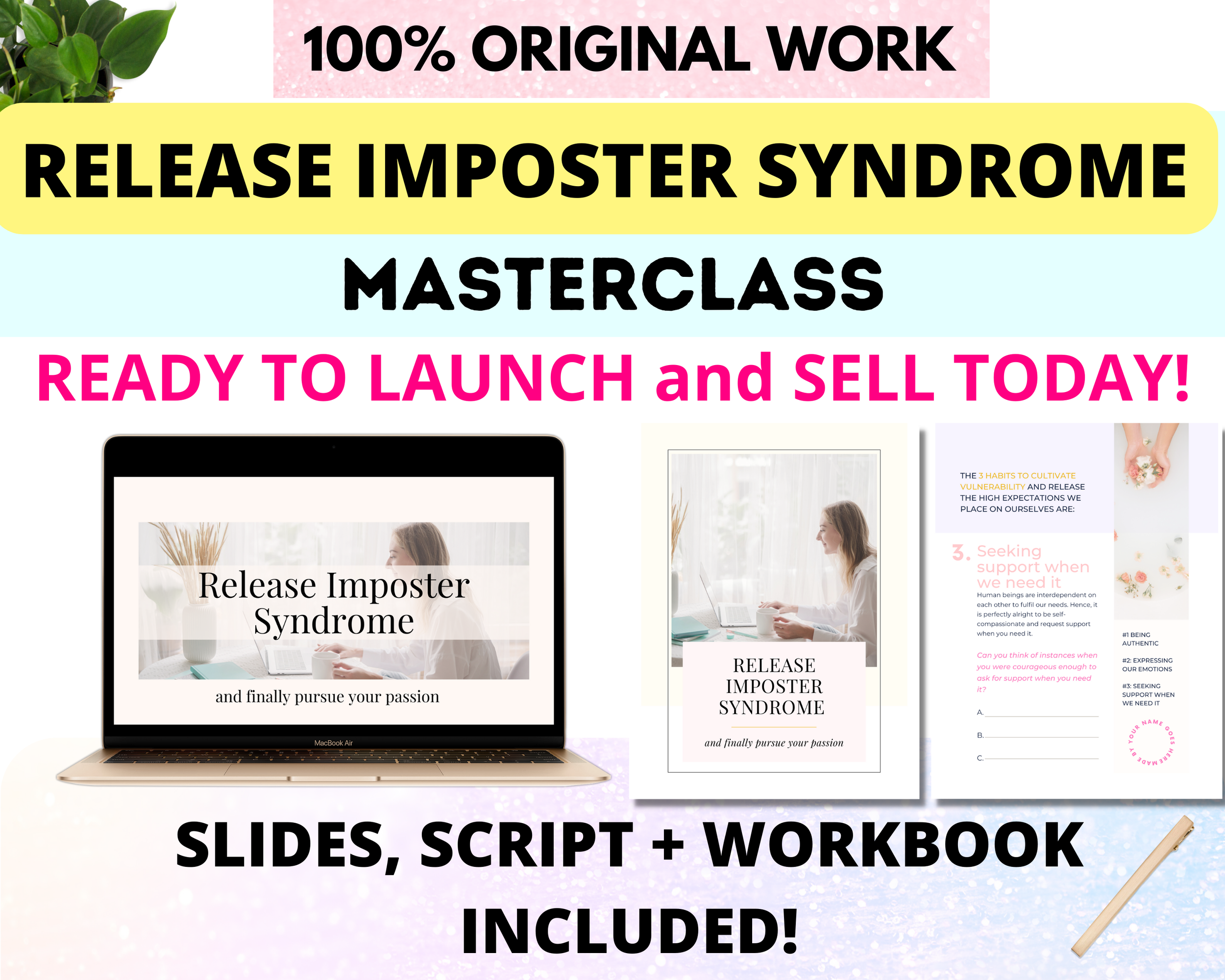
⚡️And if you want to launch + sell your own imposter syndrome masterclass without having to write your own script, create your own slides (the worst😂) or write the workbook yourself, I have the solution for you here.
Transcript
Hello friends. Welcome to another episode. I am Shikah and I used to work as a counselor, but right now I am an online entrepreneur. I've created many digital products over the years, and I've sold them as well. And today I want to talk about a particular mindset block, which can hinder you from launching something you've always wanted to launch or stop you from doing something you've always wanted to do.
If you are someone who's been playing with the idea of creating digital products and selling them, or if you are a coach or influencer or a blogger and you've always wanted to create something and sell it, but something has been stopping you, maybe you have this particular mindset block.
Alright, so the mindset block that I'm referring to is this thought that "what if nobody buys my product?" You may have that fear in your mind and this is a very common thought, especially if you have never created a digital product before, or if you are someone who has some imposter syndrome, then this thought is something not new to you, I would say.
And I don't want you to punish yourself for having these thoughts because these thoughts are more common than you think. I started my digital product business about five, six years ago in 2020. And even I have these thoughts, even though I have counseling experience, formal counseling experience, formal certifications in this topic, and I have informal certifications as well.
So I have experience and certifications and interest, but even then, I also had a ton of imposter syndrome before I started this online business in 2020. So it's nothing new and I don't want you to feel that you are, you know, you are someone who's a quote unquote 'loser' for having these thoughts because these are more common than you think.
And I'm going to share some things that you can do to shift your energy about this.
So this whole episode is not about doing mental gymnastics or some kind of mindset work for you to reframe your thoughts but I just want to shift your energy and just give you more motivation to just get startedtoday, tomorrow, or sometime soon. Alright, so when you have this thought, "what if nobody buys my products?" And then you might feel, "Oh, no. I will feel embarrassed. I'll feel ashamed. Maybe the people I know will be laughing at me. “Oh my God, she started a business and nobody's buying her products.” That's so embarrassing."
You will feel embarrassed by imaginations of failure and imaginations of doom. But your thoughts are not always real. If you are someone who is a little bit of an overthinker, a bit of a, someone who does not have a very positive mindset, your thoughts are going to be feeding you with all sorts of disaster scenarios, which may not even happen.
So acknowledge that these are just thoughts and these are just your fear based thoughts in particular. And of course, I don't want to encourage you to be totally delulu and delusional and have this rainbows and sunshine attitude and be totally ignorant of the challenges that come with this digital online space.
I want you to be positive, but also reasonably positive. I think that's what I want you to do. So what are the things that you can do to give yourself some encouragement in this aspect
is to remind yourself that you will not know if something succeeds or not until you actually start doing it. So if you always wanted to create a workshop, for example, a 30 minute workshop teaching your audience something, and you are too scared to do it, I would say just do it because you will never know whether it will fly or not until you actually do it and put it out there, and even if nobody buys it at the beginning, I don't think it's a sign that, that you are a failure or this idea is a failure. Not at all.
Because sometimes when you put something out there, it does take time for it to gain traction. It takes time for people to take notice of it and sometimes it takes time for people to consider about buying it or even to buy it.
And at the same time, if something is not selling really quickly, it can be duemto many other reasons. Maybe the marketing was not sharp enough, the positioning was not sharp enough, or maybe the topic is not something which is interesting to the audience in general. So there are actually many other factors which contribute to the product not selling as fast as you dream or as fast as you hope, and it has nothing, it probably has nothing to do with you personally.
So I want you to bear in mind that in business it may take time for things to be sold for people to pay attention to your things. It takes time to market something and not to give up immediately when something is not selling. You know, some people might just take it off the market, take it off their blog, or take it off their blog shop when nobody is buying it.
But that is not the approach that we want to take. There was one time someone I know wanted to set up a business and the thing about that is that she got really nervous about launching her business.
This is her first time doing business, I believe, and she was very caught up and nervous about launching it. But the thing is, I wanted to tell her that when you launch something, it's not going to be all "fireworks" and money coming in into your bank account unless you're someone who's pretty experienced in this area.
So sometimes when you launch something, there's crickets. Nobody's buying it. So I don't want you to place so much pressure and expectations on yourself when you are about to launch a new product or a new service or a new business, don't put that kind of unnecessary pressure on yourself because like I mentioned, it takes time for things to gain traction.
It takes time for people to get their eyeballs on your product. So don't launch something and then expect all sorts of miracles to happen on the day you launch something. And the reason why I say this is because I sometimes experience this as well because I launch digital products probably once every two months, sometimes even every month.
And sometimes I put so much expectations on a particular product. And when it does not sell as much as I hope on the first day or second day, I start feeling discouraged. And I think that is quite a silly attitude to take because sometimes it's just not the right time for your clients or customers or audience to buy your products.
And it may take a longer time for them to warm up to your products before they want to buy them. Maybe your positioning, like I mentioned, is not strong enough, so it can be due to many other reasons which are not related to you at all, this is what I want you to bear in mind, and that is, sometimes it takes time for people to buy your products and that's fine.
That's okay. Another thing that I want you to bear in mind is that sometimes your product is good enough and because of your imposter syndrome or because sometimes you have this, what I call the 'curse of knowledge', you think that your product is very basic, when in general it can be really helpful. So some of us have that kind of mindset block going on.
So when you have these mindset blocks going on, this is going to stop you as well from launching your product or slow you down from launching your product.
'Curse of knowledge' is when you think that people already know that what you are teaching. I have that also like some things come very naturally to me, but they're new to people and I've received comments, emails and also messages from people who consume my videos or my podcast episodes, for example and they say "they're so helpful" when to me they come so naturally I didn't - I wasn't even sure whether my episodes were helpful to be honest, but I do get messages and emails saying that my free content is very helpful.
So this is what I mean by the 'curse of knowledge'. Sometimes we feel that what we have is so basic, is so general, is so foundational, but that particular knowledge can be something new to someone else. It can be something that someone else learns for the first time. So you may have a curse of knowledge and that's why you have this fear that nobody's going to buy my product because "my product is so basic".
I think one of the things, the pitfalls that people fall into is that they immediately give up when they launch a particular digital product, maybe a workbook or planner or a workshop and then when nobody buys it, what they do is they immediately give up or immediately take it off their blog or take it off online shop and then stop trying.
I would say that's one of the biggest mistakes that someone can do in the online business space because sometimes it's just the copywriting on your sales page which needs tweaking.
Sometimes the products - maybe the niche or the way you position your product, the way you communicate the helpfulness or the benefits of the product needs to be tweaked. Sometimes, you just need to market it better. Maybe you need a bigger audience. Maybe you need to tap on someone else's audience, collaborate with a fellow content creator who has the same base as you, but not competing with you in terms of business.
Maybe you need collaborations to get more eyes on your product. So there are many reasons why that is not selling immediately. So don't immediately take it off your blog shop or take it off your online shop or whatever it is.
Give it a try. Tweak the messaging, tweak the sales page. Maybe you may even need to tweak the image itself - you can actually get templates online- product templates- online, Canva templates online, and you can tweak the product image to make it more appealing to your audience.
That can also be the reason why it's not getting a lot of attention. Sometimes it's the keywords that you use or you just need a bigger audience, you know? There are many reasons why it's not selling and not to just give up and stop creating and stop selling. Once you don't get the results that you want on the first day itself of launch.
So that's one of the biggest mistakes that someone can do if they are new in this online business space. So I have a shop selling done-for-you workshops, as you can see here, and workbooks in the personal development space, mindfulness, goal setting, imposter syndrome and more.
And you can actually edit these products and sell them to your audience. You can go to my shop and buy them and so that you can launch your own products with ease, with speed, and knowing that they are created with someone who actually has experience in this field- in this field of counseling and personal development.
So if you want to launch your own product quickly, you can get something from my shop and launch it. So let me know in the comments below if you have had these blocks before. You know, these thoughts of "what if nobody buys my products? What if my product is not up to standard? What if my products are not good enough?" If you have had these thoughts before, let me know in the comments section and maybe we can discuss .
Alright, see you in my next episode.
Goodbye.

What to do when you feel indecisive in your business
Today I want to talk about a topic which has been bothering me for quite some time and that is indecision. If you are new to me, I’m Shikah and I offer done-for-you coaching tools which you can sell and use with your clients.
So I have been battling feeling much indecision about my business recently and in particular two business indecisions indecision moments that I've been facing recently.
And I'm going to share with you what they are and also what I'm doing right now to handle indecision.
So if you are an overthinker like me, most probably you are not new to being indecisive and you are also someone who may take a long time to be make just a simple decision.
And I know that this is not a very healthy or and it's not a very healthy or positive way to run your business or run your life. I will share with you what I'm going to be doing for these couple of months to somehow reduce my indecisiveness and reduce my indecision moments.
So that's what I'm going to be sharing with you today. And I have to admit that I am someone who will need to to have 10 steps laid out in front of me before I take one new step.
If you are someone like that, then you know that you're going to be pretty much stuck in analysis paralysis for for a while when you want to make a new step or take a new action in your business.
Okay, so that is not exactly a healthy way to run our business and our lives. And I would say that the first indecision that I'm having right now is what I should be offering to expand my business. That is something I've been thinking about.
My Indecisive Moment #1
I've been wanting to expand my business services for a long time. I want to offer emotional and also mindset support for new entrepreneurs and also would-be entrepreneurs, people who want to start their own business. So it's something that I've been thinking about.
And then of course I'll be having all these indecision type questions, you know, such as “Should I run a low cost membership? Should I run a high cost membership because that's more sustainable and more worth my time or should I offer consultations instead? One to one consultations? Will people be paying for this?” So that's also another battle because I know that as solopreneurs, entrepreneurs, new entrepreneurs, any entrepreneur, wherever you are on the spectrum of entrepreneurship, we usually have one thing that we all want in common and that is to get more clients and to get more sales and make more money. That's essentially what most entrepreneurs want.
So I am battling this…this enthusiastic idea that I have. I have been wanting to, like I mentioned, support entrepreneurs emotionally and mind and mindset-wise.
So I was wondering, will people actually pay for that because we are all more keen or more focused on making more money? Will you pay for it? I'm not sure.
That is something that I've been battling in my mind. Should I really launch this coaching service or not? Are people going to sign up for it or what if only 3 people sign up for it? That's also not very sustainable. And so all these things are playing in my mind.
That is indecision number one.
The thing about running a business is that we have to take action. So it's not very good to be stuck in an indecisive place because when you take action, that's when you see changes and results. So taking action in business is very important.
It's not like being in a full time job where more or less every day is pretty much predictable. You do more or less the same things every day, at least in my experience when I was a counselor in the past, it's pretty much predictable. Every day you get a predictable amount at the end of the month, everything is more routine.
Whereas if you're running your own business, sometimes you put in a lot of effort to launch something and nobody buys it.
So there are more surprises. There are a lot more surprises involved when running your own business.
That is why taking action is incredibly important instead of being stuck in analysis paralysis and indecisiveness like what I am experiencing right now - just being real with you here.
I love creating workshops and workbooks for coaches. That's what I'm doing now. It's just that when I'm facing the laptop and facing books about five hours a day or more, it starts to get a bit isolating.
And I do believe that the best transformations or the fastest transformations happen when you communicate with people more directly, whether it's through podcast episodes or group coaching or one to one coaching or whatever it is - even podcasting is a form of communication because you can hear me, you can respond to me.
There are more chances of conversation there happening instead of, you know, me creating done-for-you workshops and done-for-you workbooks and you can't really communicate with me much.
I have this longing to communicate more with other solopreneurs and coaches out there. That's why I am thinking of offering some kind of coaching service for entrepreneurs and would-be entrepreneurs.
I'm still thinking about that and wondering about the logistics of it and overthinking all the details as I've mentioned. So that's the indecisiveness that I'm facing - indecisiveness number one.
My Indecisive Moment #2
I also have indecisiveness number two, which is which platform should I run this theoretical coaching membership/service on?
Okay, so as you know, there are many platforms out there and if you're starting a new venture or if you're starting to offer a new service, sometimes you are torn between paying for a platform or doing it on something free or doing it with something low-cost.
To be honest, I've never been a fan of free platforms because you will be restricted in so many ways and it just doesn't feel good energetically to conduct your business using a free platform or free service, if you know what I mean. If you are starting out from ground zero, maybe it's something you can consider.
But if you are going to treat your business seriously, running your business with a free platform is just…it's just not a good vibe because they are going to change their terms sooner or later and you're going to be stuck and then you're not going to move forward.
So that's why I'm also indecisive about which platform to run my coaching membership or coaching group or coaching business in.
And I was also thinking, should I pay a small cost for a platform? I think that's a more viable option because when you're not making any money yet because you're launching something new, you are also a bit more cautious about your ROI - Return of investment. Should I invest this amount every month when I'm not seeing money yet?
Reasonable software option #1 for launching something new
Meanwhile, let me suggest a few which can be helpful for you if you are starting out or if you are about to launch something new and you don't want to, you know, pay $99 per month for Skool’s premium plan or something like that. Skool is a course platform. It's great for running your business on.
But anyway, I saw that Payhip - Payhip.com - is actually quite a good option. It is free. They have free and paid tiers. Even though I'm not a fan of creating my business from with free platforms, but the free tier has a transaction fee.
You are essentially paying a small amount when someone buys your products. So it's not exactly free in that sense. It's not 100% free. There's a transaction fee involved and they have paid tiers as well.
And I think Payhip has been around for many, many years. So that is one option for you if you're starting out and you're not sure which option to go for when you're running your courses or memberships.
I've been running my blog on Squarespace and Squarespace has an option as well for you to sell courses and memberships. So you can consider that if you are already on Squarespace, although I do not recommend it because Squarespace’s focus is on blogging and website building. It's not exactly for running courses. So you might run into many restrictions. That’s my input about Squarespace.
Reasonable software option #2 for launching something new
So anyway, another option is Skool’s hobby plan. They have a $9 per month plan recently.
I think it's pretty decent. You get to upload your videos there and your videos are auto-captioned and, and it's very easy to just upload a course and run with it. So that is also an option for you.
Of course there will be some restrictions as well from what I see.
A few restrictions here and there, but it's still a good beginner option. So those are the options I was looking at. And you know as I mentioned, I'm overthinking this as well. So this is indecisiveness number two.
What I’ve been doing for my indecisiveness (for mental peace)
So I've got two indecisive points at this moment and what have I been doing to give myself more inner mental peace when it comes to these things is that I have been taking a so called ‘mental break’.
There is no formal word for this, so a mental break is more like - I've been reducing the mental energy I spend thinking about my business and researching and brainstorming.
If you are a solopreneur or a business owner, I think you may be able to relate to what I'm saying.
You are always brainstorming, looking out for ideas, researching. It’s always at the back of your mind. At least for me, these things are always at the back of my mind.
I've been trying to dial that down a little bit and be more present in my environment.
What I'm going to do during my ‘mental break’ is that I will still be creating podcast episodes and writing emails.
I've decided to be more active podcasting because I love communicating with you all and if you all can leave me a comment or reply back, that'll be nice. It’s a form of communication with you.
And I will also write emails because I love writing emails. So these two, I will continue on. Most likely, for this month of August 2025, I may not create a new product. I will not create a new done-for-you coaching product for this month because I want to rest my mind and because when we give our minds a break, there is more mental space for it to get creative.
Have you noticed this? Let me know.
When you take a total break, a clean break, a clean rest from your work and your mind is not racing a mile a minute thinking about : “What am I going to launch next?” “What am I going to write to my subscribers next?” You know, when your mind is totally well rested, you will realize that you have more creative ideas coming up. You have new perspectives coming up. You just get creative and then the motivation just comes naturally.
I don't know how to exactly describe it, but when you take a break the ‘correct’ way, you will have all sorts of benefits.
You experience all these benefits within yourself. You will get creative. You have ideas, you have perspectives. You get ideas which you will never get when you're trying to force them out.
Ideas will never come when you're forcing them out.
When you're stressed out and forcing yourself to come up with a new idea, forcing yourself to come up with a new angle or a new product or a new service or a new way of marketing, they will never come.
You will just stress yourself out and give yourself a headache.
What I’ve been doing for my ‘mental break’ this month
So just take a break. Take a ‘mental break’. Like I mentioned, don't think about your work at all.
Do more fun things. This is how I have been, this is what I've been doing recently. Doing more fun things - watching more fun videos on YouTube, fun makeup videos, fun celebrity videos. I love watching celebrity interviews by the way.
I've been doing that more often, doing more fun things with my daughter and family and reading more fun books, rom coms and books which are not work-related because I spend too much of my free time reading self help and personal development books because that's what my business is about.
So now I've switched to reading more rom com and fun books. This is what I've been doing to take a mental break and to give my mind a rest so that more ideas can come and I get more motivated and I get more creative ideas on the products that I can launch in future.
So that's what I've been doing. I really hope that this is helpful for you because this is what I've been doing and it has been helping me a lot mental health wise and it also helps me business wise and creativity wise.
And so do you have any ideas or any services that I can launch to help you with your business?
If you do, you can leave a comment depending on where you're catching me from.
Let me know if this is something you can relate to!
And at the same time let me know if this is something that you can relate to.
I record my podcast in a ‘live’ fashion so I don't really edit it - it’s raw and real.
If you have any ideas on a service that I can launch which is a fair exchange for both parties - not too much of an energy drain on my part and not too much of an energy drain or monetary drain on your part.
Basically, a win-win situation.
So if you have any ideas on what I can offer you, you can leave a comment in the description box or leave me an email and I will reply you.
So that's all I'm sharing today and I hope to see you in my next episode.
Goodbye!
